We have all been there: you finish writing a paragraph, a story, or an essay, sigh with relief, and slam the laptop shut. But wait! Writing is only half the battle. Without editing and proofreading, even the most brilliant ideas can get trapped under a mountain of messy sentences, missing commas, and confusing arguments.
Think of editing and proofreading like detailing a car. Writing is building the engine and the frame; editing is fixing the alignment so it drives smoothly; proofreading is washing the windows and polishing the chrome so it shines.
Whether you are a teacher looking for fresh ways to inspire your class or a student trying to level up your grades, this guide will transform your writing from a rough draft into a masterpiece.
👩🏫 The Teacher’sToolkit: How to Teach It
Teaching editing can feel like pulling teeth because students often view it as a punishment for making mistakes. The trick is to shift the mindset from "fixing errors" to "polishing treasure."
- The "Read Aloud" Revolution: Teach students to read their work out loud, or use text-to-speech software. When they read with their eyes, their brains automatically skip over typos because they know what they meant to write. When they hear it, the stumbles become obvious.
- Isolate the Issues: Do not hand back a paper covered in overwhelming red ink. Focus on one layer at a time. Have a "Clarity Day" (focusing on big-picture flow) followed by a "Comma Day" (focusing on mechanics).
- Peer Editing Mechanics: Instead of asking students to "grade" each other, give them specific scavenger hunts. For example: "Find three sentences that are longer than two lines and help your partner break them into two."
✍️ The Student’s Survival Guide: How to Do It
Editing isn't about being "bad" at writing; it is exactly what professional authors do to look like geniuses.
- Take a Breather: Never edit immediately after writing. Your brain is too tired and too familiar with the text. Walk away for at least 30 minutes—or better yet, a day.
- The Reverse Engineering Trick: If you are worried your paragraphs are confusing, try reading your essay backward—start with the last sentence and move to the first. This detaches the text from the overall story, forcing your brain to look only at the grammar and sentence structure.
- Watch the Crutch Words: We all have words we lean on too much (like really, very, just, so, or basically). Use the "Find" tool (\text{Ctrl} + \text{F}) to search for your favorite crutch words and delete them.
📋 The Ultimate Clarity & Coherence Checklist
Use this two-step checklist before you ever hit "Submit."
Phase 1: The Macro Edit (Clarity & Coherence)
The Bobbin Thread: Does every paragraph actually connect back to my main point or thesis statement?
The Transition Test: Do I use transition words (however, furthermore, consequently, in contrast) to bridge the gap between different ideas?
The Variety Check: Do my sentences vary in length? (If every sentence is short, it sounds choppy. If every sentence is long, the reader suffocates).
Phase 2: The Micro Proofread (The Final Polish)
The Verb Patrol: Did I swap out weak verbs for strong ones? (e.g., Changed "He walked slowly" to "He plodded").
Punctuation Check: Did I accidentally write any run-on sentences or fragments? Are my quotation marks properly hugging my punctuation?
Homophone Hunt: Did I double-check there / their / they're, it's / its, and your / you're? (Spellcheck often misses these!).
🧠 2 Key Takeaways
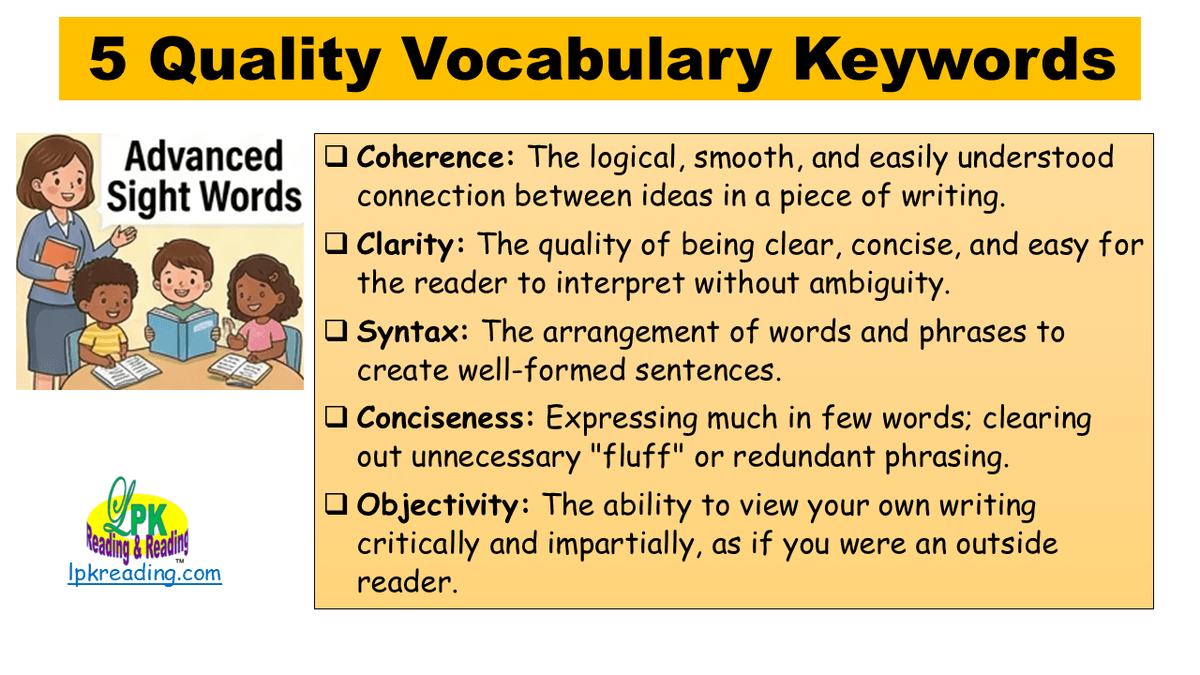
Editing and Proofreading are Two Different Things: Editing focuses on the "big picture" (clarity, structural flow, logic, and tone), while proofreading targets the "small picture" (spelling, punctuation, typos, and formatting). You must do both to succeed.
Distance Creates Objectivity: You cannot effectively edit work you just finished writing. Stepping away from your draft allows you the fresh perspective needed to spot awkward phrasing and logical gaps.